Ferns have always been among my favorite plants for shaded gardens.
They bring a sense of calm, softness, and natural elegance that is very hard to achieve with other plant groups.

What makes them especially valuable in design is their diversity — from delicate, lace-like fronds to bold, architectural forms. With such a wide range of heights, textures, and shades of green, you can always find a fern that fits beautifully into your composition.

However, there is one important nuance that often gets overlooked:
Shade is not always the same.
There is a big difference between:
- cool, moist shade near buildings, where moss often grows and the soil stays consistently damp
- and dry shade beneath mature trees, where roots compete for water and nutrients, and the soil dries out quickly
In moist shade, most ferns will grow happily with minimal effort.
But in dry shade, plant selection becomes much more critical.
Over the years, I’ve tested many species in these difficult conditions — and today I want to share my top 3 ferns that have proven to be reliable, resilient, and design-friendly in the root zones of large trees.
Polystichum munitum — The Structural Backbone

Hardiness Zone: 4–9 (up to −34°C)
Size: 90–120 cm tall and wide
This is one of the most dependable evergreen ferns for challenging conditions.
Its leathery, dark green fronds are naturally adapted to withstand drought far better than softer-textured species. Once established, it becomes remarkably resilient and requires very little maintenance — a quality that makes it especially valuable in difficult root zones beneath mature trees.
What I particularly value in Polystichum munitum is its architectural presence.
It creates volume and a strong visual framework under tall trees — something that is often missing in dry shade plantings, where compositions can easily feel flat or fragmented.
To soften its bold structure and build a more dynamic planting, I like to pair it with carefully selected companions.

One of my favorite partners is Eurybia divaricata — a beautiful, understated perennial that thrives in dry woodland conditions. I will definitely dedicate a separate post to this plant, as it truly deserves more attention.
Planted alongside this tall fern, Eurybia divaricata naturally occupies the lower layer, creating a graceful transition in height. Its airy habit contrasts beautifully with the solid mass of the fern, and in late season, it adds a delicate cloud of small white flowers — bringing light and movement into the composition.
To enrich the planting further, you can introduce:
- Helleborus for early-season interest and evergreen presence
- a small drift of ornamental grasses, such as Carex foliosissima ‘Irish Green’

Together, this combination creates a planting that feels balanced, layered, and natural — while remaining highly resilient in dry shade conditions.

Dryopteris erythrosora — Seasonal Color in the Shade
Hardiness Zone: 5–9 (up to −29°C)
Height & Width: 45–60 cm (18–24″)
This fern adds something quite rare to shaded plantings — a gentle, seasonal shift in color that brings the composition to life.
In spring, the young fronds unfurl in warm shades of copper, soft amber, and blush pink. As the season progresses, these tones gradually deepen into a rich, glossy green. This natural transition creates a sense of movement and subtle change, preventing shaded areas from feeling static or flat.

Although it looks delicate, Dryopteris erythrosora is more resilient than it appears. Once well established, it adapts surprisingly well to drier woodland conditions, making it a reliable choice for planting under mature trees.
To highlight its character, I often pair it with plants that offer both textural and color contrast.
A good companion plant for Dryopteris erythrosora is Carex montana ‘Raureif’. Its fine, arching foliage with soft variegation brightens the planting and introduces a lighter visual rhythm, creating a flowing ground layer that gently contrasts with the fern’s deeper tones.
Another strong partner is Geranium phaeum ‘Samobor’. Its darker foliage and delicate, almost floating purple flowers add depth and a more natural woodland feel. The upright yet airy structure of the geranium works beautifully against the layered texture of the fern.

Together, these plants form a composition that feels balanced and expressive — combining softness, contrast, and seasonal interest while remaining stable and reliable in dry shade conditions.

Asplenium scolopendrium — Texture and Contrast
Hardiness Zone: 5–9 (up to −29°C)
Height & Width: 30–45 cm (12–18″)

This fern has a completely different character compared to most classic fern species.
Instead of finely divided fronds, it forms smooth, glossy, strap-like leaves that instantly introduce a strong sense of structure and contrast within a planting.
If you need a simple and reliable plant palette to cover areas beneath mature trees, you can start with a base of Carex albicans or Carex rosea.
On top of this fine-textured layer, introduce small groups of bold-leaved plants for contrast — such as Asplenium scolopendrium and Bergenia. Their broader, more sculptural foliage creates a clear visual structure against the softness of the sedge.
To bring in a touch of color and seasonal interest, you can add Geranium nodosum, which weaves naturally through the planting and softens the transitions between layers.

Even this minimal combination is often enough to create a strong and balanced composition, where the light, grassy texture of the sedge is complemented by the architectural presence of larger leaves and subtle flowering accents.

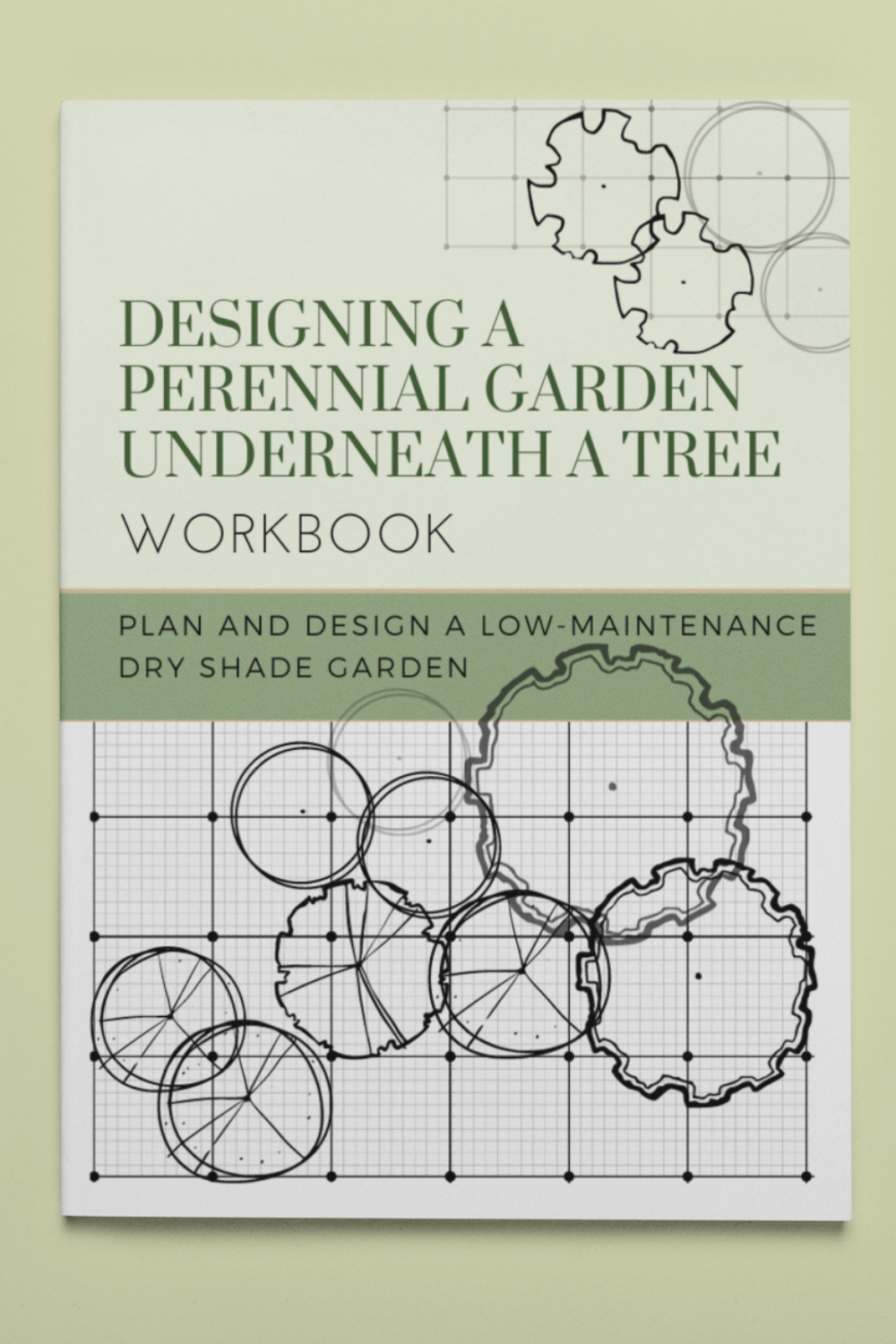
If these types of planting combinations help you feel more confident in your plant choices, I recommend taking a look at my workbook.
It includes a curated palette of reliable plants for dry shade under mature trees — all tested in real conditions. I’m confident you’ll discover combinations that not only survive, but truly thrive.
You can download my workbook Naturalistic Planting Design Under a Large Tree here.


Leave a Reply