Over the past several years, gardeners across Europe have experienced increasingly extreme weather conditions. Long periods of drought, unusually high summer temperatures, and in some regions even restrictions on watering private gardens have become part of the new reality.
As a result, many traditional garden plants are no longer performing as reliably as they once did. This makes plant selection more important than ever, especially on sites exposed to full sun and areas with light, free-draining soils that are naturally low in organic matter.
Fortunately, nature has already provided us with many solutions. A wide range of ornamental grasses, perennials and shrubs have evolved in dry, sunny environments and are naturally adapted to these challenging conditions.

For this reason, I am starting a series on drought-tolerant plants suitable for naturalistic planting design.
Before we begin looking at individual species, however, I would like to introduce the design framework I use when creating planting schemes. To make the process easier to follow, I will illustrate each step.
Understanding Plant Functions Within a Border
When creating a planting scheme, it is not enough to simply choose plants that tolerate drought. The most successful compositions are created when we understand the role each plant plays within the overall design.
I divide plants into seven functional layers:
Structural Foundation Layer — ornamental grasses and other permanent elements that create the framework of the planting.
Structural Anchor Perennials — long-lived plants that establish the architectural backbone of the composition.
Mass Color Perennials — repeated groups of flowering plants that create the main seasonal waves of colour.
Supporting & Filler Perennials — connecting plants that soften transitions between larger elements and unify the planting.
Scattered Structural Accents — occasional architectural plants that introduce contrast and visual interest within larger planting areas.
Dynamic Movement — shorter-lived and self-seeding plants that bring change, movement and natural regeneration to the planting.
Seasonal Extensions — geophytes that extend ornamental interest from early spring into summer.
Many plants can perform more than one role within a planting scheme, but this framework helps us understand their primary function and the contribution they make to a balanced composition.
This is also the order I usually follow when developing a planting plan.
Step 1 — Structural Foundation Layer
Every planting begins with a strong framework.
In a perennial border, this usually means starting with ornamental grasses, although evergreen shrubs and small trees can also be introduced to create permanent focal points.

For this example, I will use Pinus mugo ‘Winter Gold’ as the main evergreen accent.
Around the pine, I establish broad drifts of Sesleria autumnalis, complemented by individual groups of Festuca mairei.
To introduce stronger vertical elements, I add Stipa gigantea. This grass provides dramatic height and movement, although it performs best in very well-drained soils. In regions with wet winters, I would replace it with Calamagrostis × acutiflora ‘Karl Foerster’, which is more reliable under those conditions.
These plants create the permanent structure of the planting. They remain attractive throughout the year, require minimal maintenance and can remain in place for many years without division.
At this stage, do not worry about achieving the final perfect arrangement. The goal is simply to establish the main structural masses. Their exact position and quantity can be adjusted as the design develops.
Step 2 — Structural Anchor Perennials
Once the main structure is established, I begin adding long-lived architectural perennials.
This group may include:
- Euphorbia characias
- Phlomis russeliana
- Amsonia hubrichtii
- Salvia yangii (formerly Perovskia atriplicifolia)
- Eryngium yuccifolium
- Yucca filamentosa
For this example, I will use several groups of Yucca filamentosa and create loose naturalistic drifts of Salvia yangii ‘Denim ‘n Lace’ between them.

These plants create the permanent backbone of the composition. They remain stable in the same position for many years, develop strong architectural forms and require little intervention once established.
Step 3 — Mass Color Perennials
After the structural framework is complete, we can introduce the plants responsible for the main seasonal displays.
For this planting, I will use:
- Achillea ‘Firefly Peach Sky’ for early summer colour;
- Agastache ‘Blue Fortuna’ for mid- and late-summer flowering;
- Helenium autumnale ‘Moerheim Beauty’ to extend the flowering season into late summer.
These repeated groups create rhythm and bring the main waves of colour into the planting.

Mass Color Perennials are often very rewarding in the first years after planting. Many flowering perennials establish quickly, reach their mature size within a relatively short period of time and provide the strong seasonal colour that makes a planting feel abundant and dynamic.
However, many of the plants in this group require more regular maintenance than structural perennials and ornamental grasses. Species such as Achillea, Salvia and Helenium often benefit from division every 3–5 years to maintain their vigour and flowering performance.
This does not make them a poor choice — their exceptional flowering, colour range and seasonal impact are exactly why they are so popular. However, when selecting these plants, it is important to consider how much maintenance you are willing to include in your garden routine.
The quantity of Mass Color Perennials in a design should reflect this balance.
For example, large drifts of Achillea or Salvia can create a spectacular display during flowering, but after several years these clumps may need to be lifted and divided. Some divisions can be replanted in the original area, while the remaining plants can be moved to new parts of the garden or shared with friends and neighbours.
This is an important consideration when designing with many colourful flowering perennials.
For lower-maintenance gardens, I recommend creating a stronger foundation of long-lived structural plants and ornamental grasses, and using flowering perennials as seasonal accents rather than the dominant element of the composition.
Step 4 — Supporting & Filler Perennials
The next step is connecting the stronger structural plants and flowering perennials with lighter, softer species:
Nepeta × faassenii
Calamintha nepeta subsp. nepeta
Origanum (Ornamental Oregano)
Summer Alliums
Echinacea pallida
For this role, I would use Calamintha nepeta subsp. nepeta.

Its airy growth habit creates a gentle transition between larger plants, fills smaller spaces and helps unify the overall composition.
Step 5 — Scattered Structural Accents
When a planting contains many grasses, occasional architectural accents help introduce additional texture and contrast.
For this example, I will add Iris pallida.

Its upright foliage creates another layer of structure, while its seasonal flowering adds additional interest.
Step 6 — Dynamic Movement
The Dynamic Movement layer describes plants that bring change, lightness and seasonal variation into a planting over time. These species are not intended to create permanent structure, but rather to complement the stable framework created by structural and matrix plants.
From a design perspective, this layer introduces rhythm and movement within an established planting, allowing the composition to evolve naturally rather than remain completely static.
Typical species include:
- Oenothera lindheimeri (formerly Gaura lindheimeri)
- Verbena bonariensis
- Lychnis coronaria
- Knautia macedonica
Design role
In planting compositions, Dynamic Movement species are used to:
- soften transitions between structural and mass plantings;
- introduce vertical rhythm and fine texture;
- create seasonal change without redesigning the planting;
- naturally occupy small spaces that appear over time.
These plants are most effective when used as scattered individuals or small groups, allowing them to weave through the planting rather than create dominant blocks.
For this example, I use Oenothera lindheimeri and Verbena bonariensis to introduce lightness and movement among the flowering perennials.

To create additional movement within the grasses, I also add Stipa tenuissima ‘Pony Tails’.
I particularly like using this grass around young Yucca filamentosa and Pinus mugo ‘Winter Gold’ while these structural plants are still developing. It creates a soft, natural transition between the permanent framework and the surrounding planting.
However, I would avoid placing it as a dominant foreground element in regions with wet winters, as individual plants may occasionally disappear and leave noticeable gaps.
One of the important functions of Dynamic Movement species is their ability to support natural regeneration. Some plants in this group gradually disappear or move through the planting, while their self-seeding habit allows them to occupy available spaces and maintain continuity over time.
This dynamic behaviour is especially valuable in long-term naturalistic gardens. Every planting changes as plants grow, compete and decline. When desirable self-seeding species are already present within the planting, they can naturally fill emerging gaps before less suitable species become established.
At the same time, these plants rarely become problematic in a dense, healthy planting because strong competition limits where new seedlings can successfully establish.
Step 7 — Completing the Lower Layer
At this stage, I look for remaining open spaces, especially in the foreground.
For this planting, I would add Thymus praecox ‘Coccineus’ to create a low-growing carpet layer.

It can be used both along the front edge of the border and around structural plants such as Yucca and Pine while they are still young and developing.
Seasonal Extensions
The final step is adding geophytes that extend the ornamental season from early spring into summer.

These plants create interest before the perennial planting reaches full growth and help ensure that the garden remains dynamic throughout the year.
Creating a Balanced, Resilient Planting
Using this functional layering approach allows us to create much more than a collection of drought-tolerant plants.
Instead, we build a balanced plant community with a permanent framework, seasonal flowering, movement and natural regeneration.
Each plant has a purpose within the composition, allowing the planting to remain attractive and resilient for many years with relatively little maintenance.
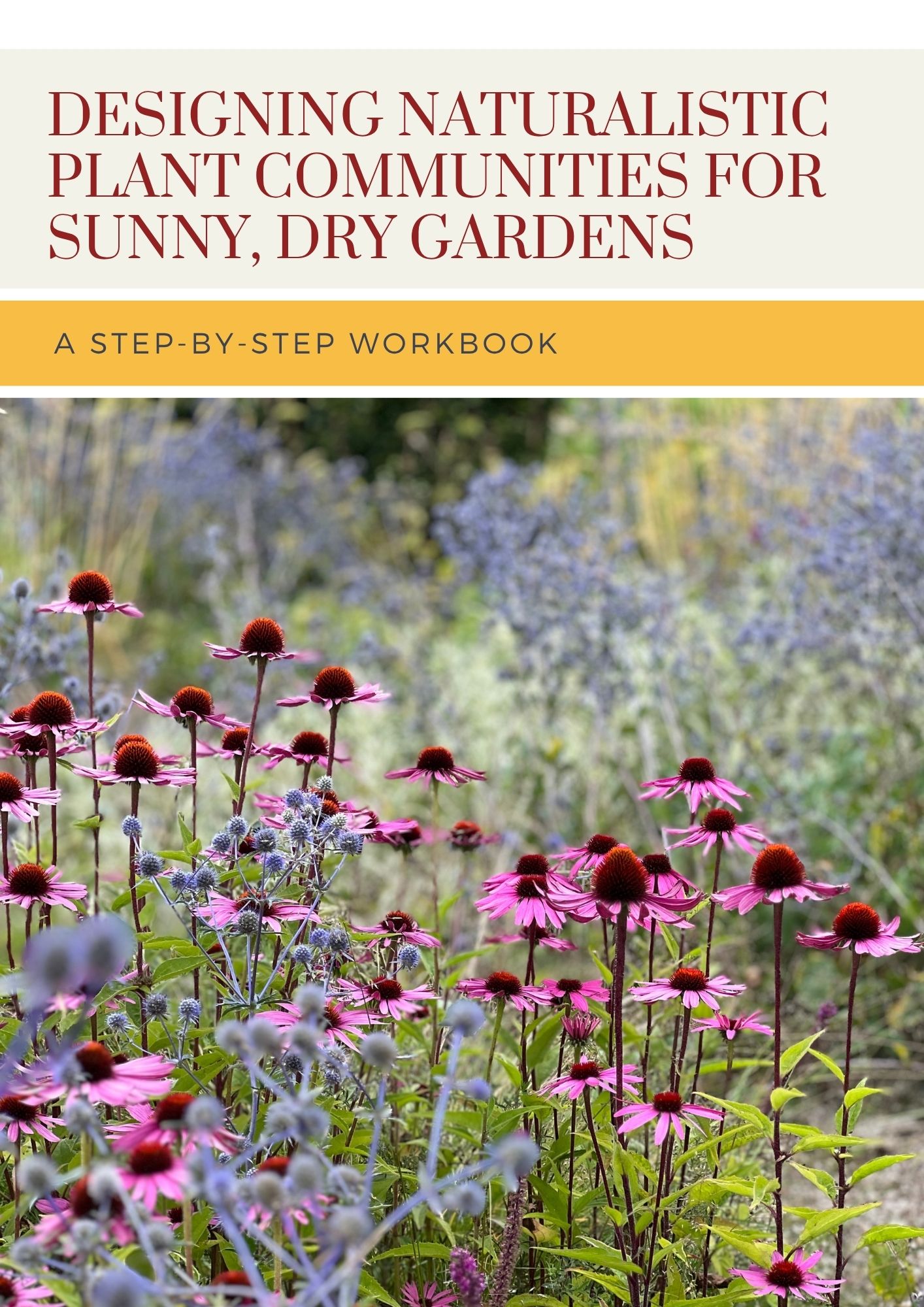
If you would like to explore this method in more detail, I explain the complete process in my workbook Designing Naturalistic Plant Communities for Sunny, Dry Gardens
You will find additional examples of plant combinations for full sun and poor soils, detailed planting strategies, spacing recommendations and step-by-step guidance on creating naturalistic planting schemes.


Leave a Reply