Knautia macedonica is one of those perennials that quietly captures attention.

Its beauty does not come from dramatic architectural flowers or a bold structural presence. Instead, it offers something much more subtle: lightness, movement, and a sense of natural rhythm.
With its airy flower heads, relaxed growth habit, and exceptionally long flowering period from early summer into autumn, it weaves delicate accents throughout a planting rather than competing for attention.
That is exactly why Knautia has become such a valuable plant in naturalistic planting design.
It connects stronger visual elements, softens transitions, and brings a planting closer to the feeling of a natural meadow. Its flowers are also highly attractive to butterflies and other pollinators, adding ecological value alongside its ornamental qualities.
But despite all these strengths, I believe Knautia is also one of those plants that is often placed in the wrong conditions.

To understand why, we first need to look at where it comes from.
Where does Knautia macedonica grow in nature?
Knautia macedonica is native to Southeastern Europe, including North Macedonia, Bulgaria, Greece, Albania, Romania, and European Turkey.
In nature it grows in open, sunny habitats with excellent drainage—dry grasslands, rocky slopes, and other well-drained landscapes where plants have adapted to strong sunlight, periodic drought, limited nutrients, and constant competition from neighbouring species.
Its preferred soils are sandy, stony, or calcareous, typically neutral to alkaline and always well drained.
For me, this is where plant design begins.
When we understand the environment that shaped a species, we understand how to use it successfully in a garden.
Knautia performs best in full sun and moderately fertile to poor, well-drained soils.
Understanding its life strategy
Another characteristic that completely changes how I think about Knautia is its life cycle.
It is considered a short-lived perennial.
Individual plants gradually decline after several years, but the species persists through self-seeding.
Under suitable conditions, new seedlings establish wherever small gaps appear within the planting. The self-seeding is usually moderate rather than aggressive, becoming part of the planting rather than overwhelming it.

This is exactly why, in my workbook, I place Knautia within the Dynamic Movement functional group—self-seeding and short-lived perennials that bring change and regeneration into naturalistic plantings.
Unlike structural plants, their purpose is not to remain permanently in one place. Instead, they introduce movement, seasonal variation, and renewal.
Individual plants may disappear, while new seedlings establish elsewhere. The planting itself continues to develop without losing its overall character.
Rather than freezing a design in time, these plants allow it to evolve naturally. For me, this is one of the defining characteristics of resilient plant communities.
Finding the right place for Knautia
When Knautia first became widely available, I often planted it alongside roses.
Visually, it was a beautiful combination.
Its delicate burgundy flowers floated effortlessly among white, yellow, and pink roses.

But over time I realised that the two plants were asking for very different conditions.
Rose borders are usually rich in compost, regularly fertilised, and carefully maintained.
Knautia evolved in almost the opposite environment. In highly fertile soils I noticed that it became taller, softer, and lost much of the airy character that had attracted me in the first place. It also became more susceptible to powdery mildew where airflow was reduced.
That completely changed how I use this plant.
Today I think of Knautia as a perennial for spartan conditions—open sunny sites shared with drought-tolerant grasses and perennials that thrive without excessive fertility.
Designing with plant functions
Here is one example of how I would use Knautia macedonica within a planting.
Rather than relying on it as a dominant species, I use it as one functional layer within a much larger plant community.

The permanent framework is created by long-lived structural plants.
Sporobolus heterolepis forms the primary structural grass, providing a framework that can remain attractive for decades.
Because Sporobolus emerges relatively late in spring, I combine it with earlier-flowering species such as Knautia macedonica, Echinacea pallida ‘Hula Dancer’, ornamental Allium, and Eremurus himalaicus, extending seasonal interest before the grass reaches its full height.
To strengthen the matrix, I include the cool-season grass Sesleria autumnalis, while long-lived structural perennials such as Amsonia hubrichtii and Phlomis russeliana reinforce the planting over time.

The flowering layer is supported by reliable mass-colour perennials including Salvia nemorosa, Hylotelephium, and Symphyotrichum oblongifolium ‘Raydon’s Favorite’, with Calamintha nepeta and Origanum ‘Drops of Jupiter’ softening the composition as filler species.


Every plant has a clearly defined role.
Even if individual Knautia plants disappear after a few seasons—as short-lived perennials naturally do—the structure of the planting remains intact.
The long-lived grasses and structural perennials continue to provide stability, while new Knautia seedlings can gradually establish wherever suitable opportunities arise.
This is exactly how I like Dynamic Movement plants to function: not as permanent features, but as species that keep a planting alive and constantly renewing itself.
A beautiful planting—but will it last?
Recently I visited a park where Knautia macedonica was planted in large drifts together with Deschampsia cespitosa.

My first reaction was simple: How beautiful!
The evening light, the movement of the grasses, the floating flowers—it was everything we love about naturalistic planting.

But then another question came to mind. How will this planting look ten years from now?
Deschampsia may require rejuvenation over time to maintain its best appearance, while Knautia depends on successful self-seeding to remain present.

Perhaps the designers intended the planting to evolve.
Perhaps other structural species will gradually become more dominant.
Perhaps self-seeding will successfully sustain the population.
Only time will answer those questions.
Personally, although I find the combination incredibly beautiful, I would hesitate to rely on these two species alone as the long-term backbone of a planting.
Final thoughts
For me, Knautia macedonica remains one of my favourite Dynamic Movement plants for sunny, well-drained gardens.

Its role is not to provide permanent structure.
Its role is to bring movement, colour, spontaneity, and natural regeneration into a stable framework created by long-lived structural and matrix plants.
When we begin to understand plants through their ecological strategies rather than simply their appearance, our planting designs become not only more beautiful—but also more resilient over time.
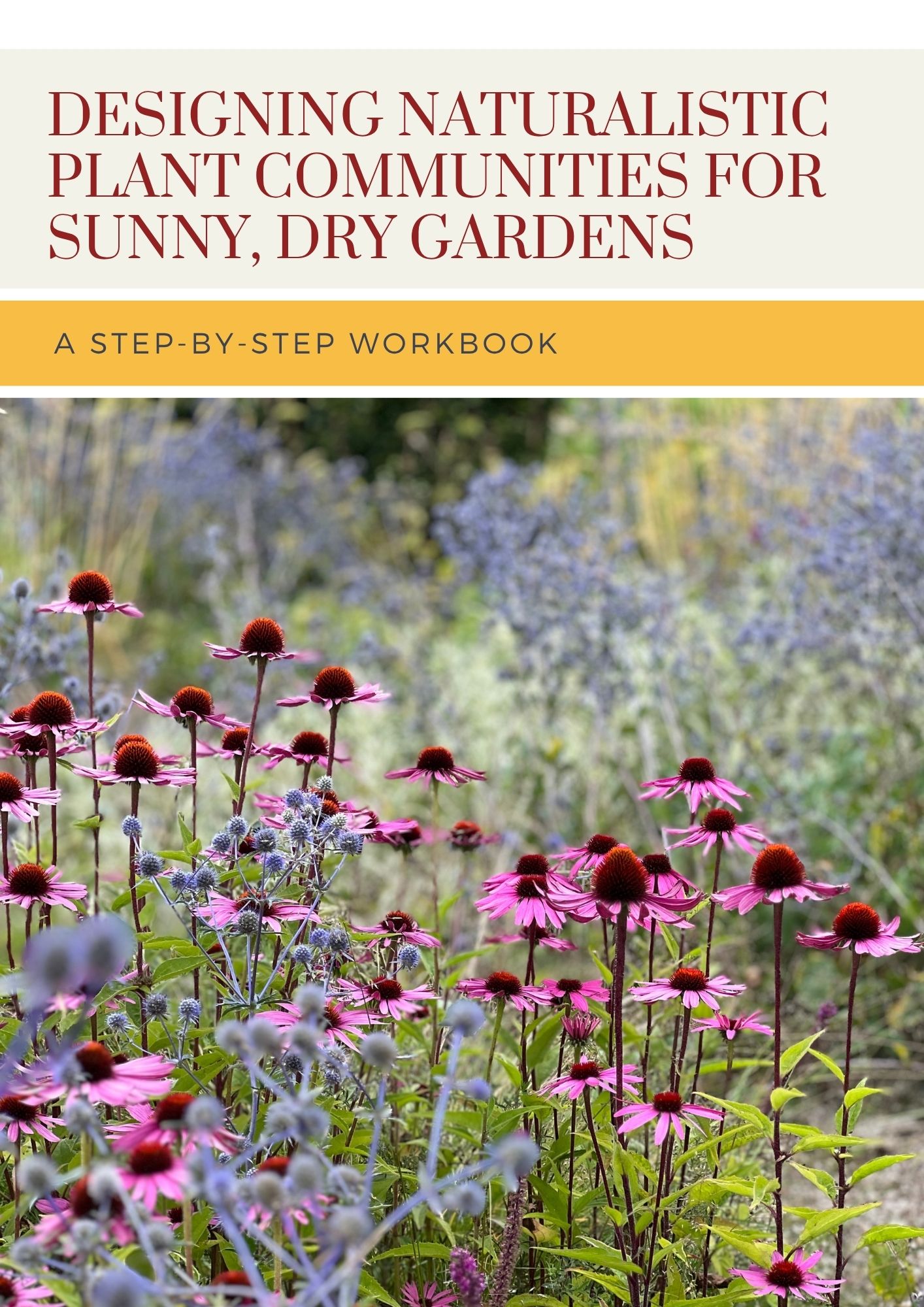
If you want to understand the functional roles of different plant groups in naturalistic gardens, I invite you to explore my workbook ‘Designing Naturalistic Plant Communities for Sunny, Dry Gardens’, where I explain these planting layers in detail, introduce representative plants, and show how they can be combined to create planting communities that develop beautifully over time.


Leave a Reply